Existentialism in Russian Literature: Dostoevsky vs. Tolstoy
The foundation of existentialism in Russian literature was not laid by formal philosophers but by novelists who probed the darkest corners of the human soul. Long before Sartre and Camus popularized the term, Fyodor Dostoevsky and Leo Tolstoy were already grappling with the fundamental anxiety of existence: What does it mean to be free? And is life inherently meaningful?
While their approaches to Dostoevsky’s existential themes and Tolstoy’s philosophy of life differed dramatically, they shared a common stage. Nineteenth-century Russia was a powder keg of rapid Westernization, decaying serfdom, and rising nihilism. This turbulent environment forced intellectual figures to confront an existential void. Both Dostoevsky and Tolstoy used the novel as a philosophical laboratory, placing their characters in extreme situations to test the limits of their beliefs, morality, and sanity.
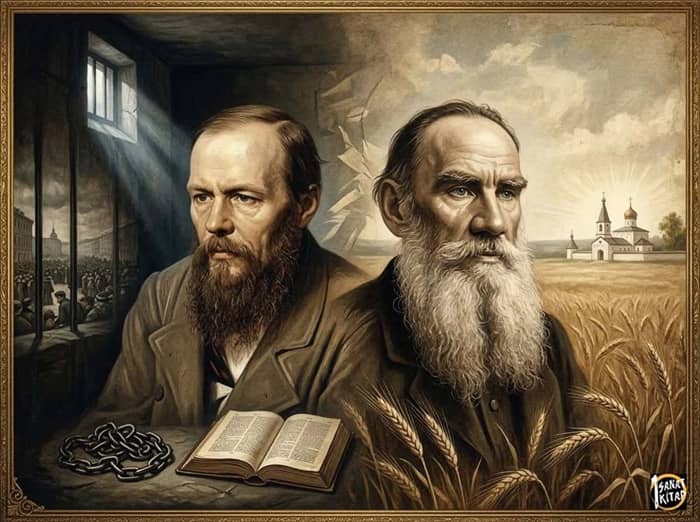
Existentialism in Russian Literature: Dostoevsky vs. Tolstoy
Existentialism in 19th Century Russian Literature: Dostoevsky vs. Tolstoy
Dostoevsky: The Descent into the Underground Man
If we seek the point where the technical definition of existentialism in Russian literature truly begins, we find it in the “underground.” Dostoevsky’s Notes from Underground is the quintessential pre-existentialist text. The unnamed narrator, known as “The Underground Man,” is a walking contradiction. He is hyperconscious, spiteful, and paralyzed by his own freedom.
The Underground Man is a rebellion against the prevailing Western idea of “Rational Egoism”—the belief that if humans are logical and act in their own self-interest, they will inevitably create a perfect society. Dostoevsky argued that this logic ignores the core of human nature: the desire for irrational, unfiltered choice, even if it is destructive. The statement “Twice two makes four is an excellent thing… but twice two makes five is also sometimes a very charming thing” is the Underground Man’s declaration of existential freedom. He would rather suffer and be a contradictory, suffering individual than be a logical, happy “piano key” in a utopian society.
Guilt and Redemption: The Brothers Karamazov Analysis
Dostoevsky’s masterpiece, The Brothers Karamazov, is perhaps the single most important document on Dostoevsky existential themes. Through the three brothers—Dmitri (passion), Ivan (intellect), and Alyosha (faith)—Dostoevsky explores the question of freedom and guilt in art.
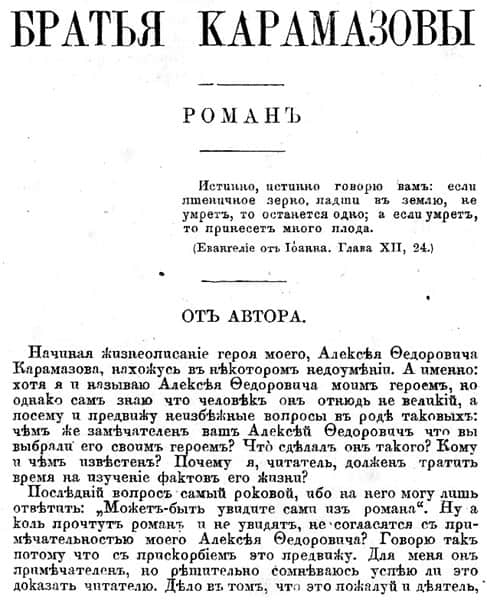
The Brothers Karamazov by Fyodor Dostoevsky – Existentialism in Russian Literature: Dostoevsky vs. Tolstoy
Ivan Karamazov represents the modern existential crisis. His intellect leads him to the logic of “If there is no God, everything is permitted.” But Ivan is a tragic figure, not a villain. His logic brings him not freedom, but madness.
He is tortured by the suffering of innocent children and cannot accept a world with such inherent cruelty, even if a higher purpose is promised. His profound guilt over the murder of his father, even though he didn’t pull the trigger, is a testament to the idea of “Radical Responsibility”—a key pillar of later existentialist thought. We are not only responsible for our own actions but also for the state of the world we inhabit. Alyosha, the foil to Ivan, offers a different existential choice: active, irrational love as the only defense against the absurdity of existence.
Tolstoy: The Hunt for Authenticity
While Dostoevsky looked inward to the psychological, Leo Tolstoy looked outward to the social and historical. Tolstoy’s philosophy of life was built upon a relentless search for authenticity and a profound anxiety about death. Tolstoy’s existential crisis, which he detailed in A Confession, was a paralyzing realization that, despite his wealth, fame, and family, his life was meaningless because it was finite.
Unlike Dostoevsky’s characters, who suffer from hyperconsciousness, Tolstoy’s characters often suffer from a lack of consciousness. They are trapped in the inauthentic social roles that society demands. His works are full of characters who are alive but already metaphorically dead because they are not living their own truth.
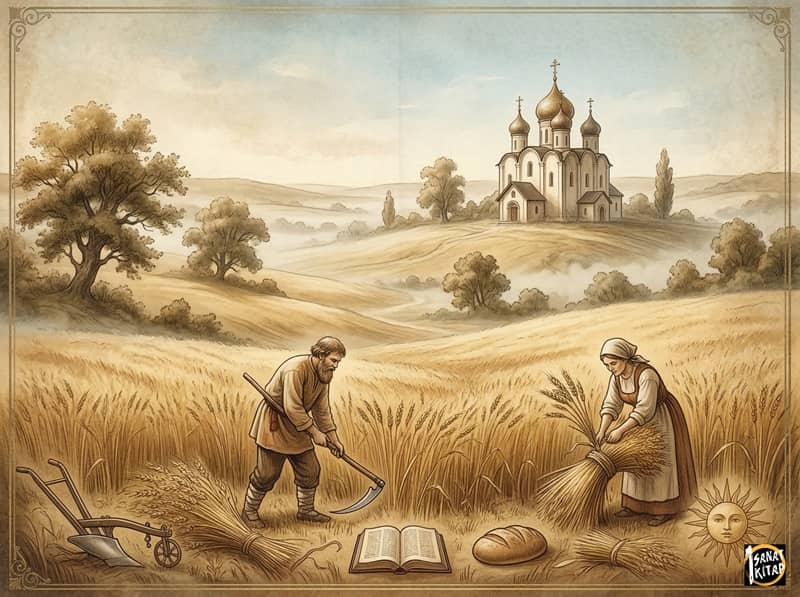
A symbolic representation of the simple life in Tolstoy’s existential philosophy. Two Russian peasants work in a golden wheat field in earth and gold tones, illustrating the authentic, collective, and pastoral existence that Tolstoy believed offered salvation from modern absurdity, contrasted with the distant monastery representing spiritual integrity.
Recommended For You – Jean-Francois Millet’s The Gleaners Analysis
The Confrontation with Mortality: The Death of Ivan Ilyich
The pinnacle of Tolstoy’s existential analysis is the novella The Death of Ivan Ilyich. The opening sentence reveals that Ivan’s life “was most simple and most ordinary and therefore most terrible.” This isn’t just a story about a man who dies; it is about a man who realizes he never truly lived.
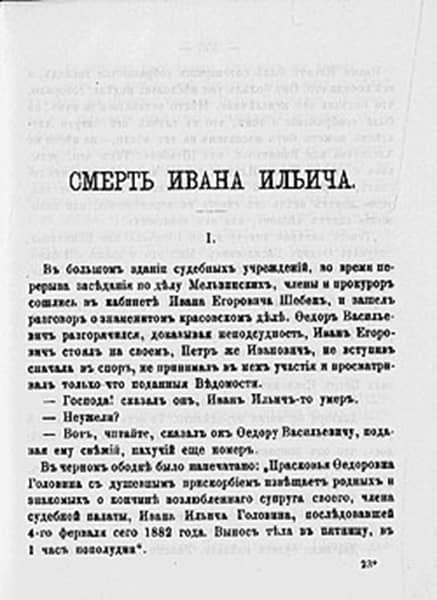
The Death of Ivan Ilyich by Leo Tolstoy
Ivan Ilyich is a successful judge who has spent his entire life doing what he believed was expected of him by his class. As he faces a painful, terminal illness, his entire inauthentic life crumbles. He is forced to confront the absolute solitude of death, a core Pre-existentialism theme. The tragedy is that he spent his existence pleasing a society that doesn’t care about him, ignoring his own “search for meaning.” It is only in his final, suffering hours, as he connects with the suffering of his son, that he finally finds a moment of true, authentic existence and finds peace.
Philosophy of War and Peace: The Individual in the Sweep of History
Tolstoy’s epic, War and Peace, is often analyzed for its sweep of battles and political maneuvering, but its true heart is an existential struggle. The War and Peace philosophy revolves around how the individual can find purpose in a world where history feels like an unstoppable, predetermined force.
The character of Pierre Bezukhov embodies this journey. He spends years searching for meaning in all the wrong places—wealth, high society, Freemasonry—only to find it as a prisoner of war, stripped of everything. It is through suffering and his encounter with the simple, authentic faith of a peasant that Pierre finds his purpose. Tolstoy, in stark contrast to Dostoevsky, believed that existential salvation was found not in a unique identity but in a return to a simpler, collective, and pastoral truth, far removed from the corruption of the city and the hyperintellectual.
Conclusion: Two Titans, One Crisis
Both Fyodor Dostoevsky and Leo Tolstoy recognized that the 19th-century soul was in crisis. Their works are the bedrock of existentialism in Russian literature, even if they never used the word. Dostoevsky found meaning in the individual’s choice to suffer for love; Tolstoy found it in the individual’s choice to live an authentic, simple life. Their debate—between the hyperconscious psychological and the authentic social—remains as vital today as it was then. By making Brothers Karamazov analysis and War and Peace philosophy central to their work, these titans of the word created a permanent repository of existential truth, one that any reliable academic must reference to understand the origins of the modern condition.
(References)
- Dostoevsky, F. (1864). Notes from Underground.
- Tolstoy, L. (1886). The Death of Ivan Ilyich.
- Shestov, L. (1903). Dostoevsky and Tolstoy: Existentialist and Religious Philosophies. University of Ohio Press.
- Frank, J. (2009). Dostoevsky: A Writer in His Time. Princeton University Press.
- The Great Courses: Russian Literature from Dostoevsky to Tolstoy.
- Wikipedia: The Brothers Karamazov
- Wikipedia: The Death of Ivan Ilyich