Best Art Books
Before stepping into any gallery, reading the best art books can transform how you see, interpret, and emotionally connect with artworks. This guide highlights the essential titles every art lover should explore before visiting a museum. Reading these books equips you with visual literacy, historical context, and symbolic understanding—skills that dramatically transform the way you experience any museum collection, from Renaissance masterpieces to contemporary installations.
Choosing the right books for art lovers can completely transform your museum experience. When you understand artistic movements, symbolism, visual language, and the lives of great painters, every gallery visit becomes richer, more immersive, and unforgettable. Whether you’re preparing for the Louvre, the Uffizi, the Met, or a local museum, these essential books will deepen your appreciation of the masterpieces you encounter.
This extended guide doesn’t just list books — it explains why, how, and for whom each book is valuable. Whether you’re a beginner or a casual art admirer, this reading roadmap will elevate your experience.
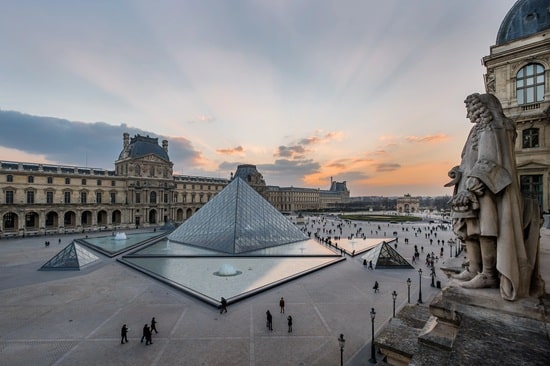
Louvre Museum – Paris, France – Best Art Books – Books to read before visiting a museum.
Why Reading Before Visiting a Museum Matters
Art museums can be overwhelming—centuries of history, unfamiliar iconography, and hundreds of artworks competing for your attention. Reading key books beforehand helps you:
- Decode symbols, including those central to Renaissance Art Symbolism.
- Understand cultural and historical references.
- Recognize artistic techniques and innovations.
- Engage emotionally and intellectually with artworks.
- Move beyond passive viewing into informed interpretation.
Recommended For You – The 10 Best Art Museums in the World

The Night Watch, 1642 by Francisco de Goya – Rijksmuseum Amsterdam, Netherlands – Best Art Books.
How This Reading List Is Organized
To support different learning goals, each recommended book falls into one of these categories:
- Foundational Art Understanding
- Historical Context
- Renaissance Symbolism & Visual Codes
- Artist Biographies
- Modern & Global Art Understanding
- Practical Museum-Viewing Strategies
You can follow the list chronologically or select based on your upcoming museum visit.
10 Books Every Art Lover Should Read Before Visiting a Museum
1- The Story of Art — E.H. Gombrich
The Best-Selling Art History Book of All Time
”The Story of Art” is the single most influential art history book ever written. For more than 70 years, it has been used as the primary introductory text in universities, museums, and art academies around the world.
Gombrich’s famous first sentence sets the tone:
”There is really no such thing as Art. There are only artists.”
This approach revolutionized art education because it focused on human creativity rather than dry historical facts. The book traces visual representation from prehistoric cave art to modernism, explaining why techniques, beliefs, and styles changed over time.
Widely considered the most accessible introduction to art history, this classic traces Western art from prehistoric cave paintings to the 20th century.
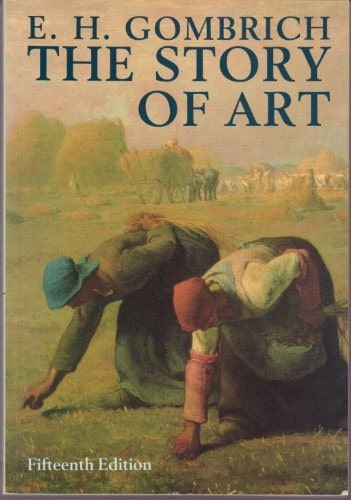
The Story Of Art by E.H. Gombrich – Best Art Books
What You Will Learn:
- Major art movements explained in simple language.
- How was perspective invented in the Renaissance?
- Why does medieval art look flat compared to Greek art?
- How have artistic ideas evolved through time?
- The emotional intensity of the Baroque.
- How modern art broke with realism?.
Perfect before visiting: Any major museum with Western collections (e.g., Louvre, National Gallery, Rijksmuseum).
2- Ways of Seeing — John Berger
A Transformative Guide to ‘How’ We Look at Art
Berger’s work became groundbreaking because it questions everything we think we know about images. He analyzes the male gaze, consumer culture, and the reproduction of art — long before these ideas became mainstream.
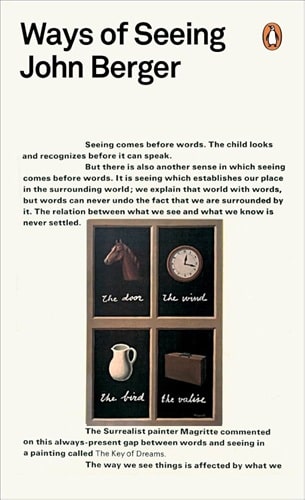
Ways of Seeing by John Berger – 10 Best Art Books to Read Before Visiting a Museum.
”Seeing comes before words. The child looks and recognizes before it can speak.
But there is also another sense in which seeing comes before words. It is seeing which establishes our place in the surrounding world; we explain that world with words, but words can never undo the fact that we are surrounded by it. The relation between what we see and what we know is never settled.
The surrealist painter Magritte commented on this always-present gap between words and seeing in a painting called The Key of Dreams. ”
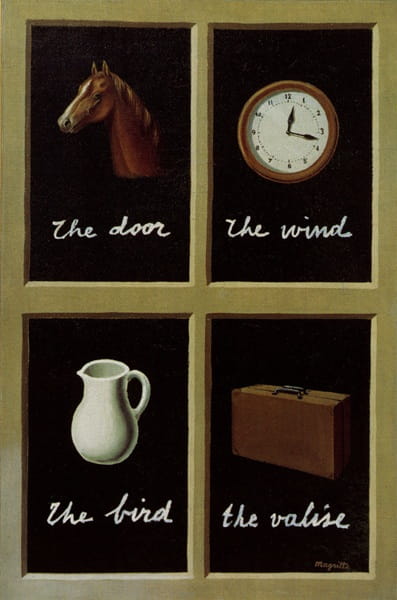
La Clef des songes (The Interpretation of Dreams) by René Magritte – Brussels, 1935.
Recommended For You – Surrealism Art Movement
What You Will Learn:
- Why do reproductions change the meaning of a painting?
- How does advertising use classical visual codes?
- How does social context shape perception?
- Why does objectification appear in Western oil painting?
3- The Lives of the Artists — Giorgio Vasari
The First Art History Book Ever Written
Vasari personally knew or interacted with many major Renaissance figures and left behind vivid, narrative biographies.
Giorgio Vasari‘s biographical collection ‘The Lives of the Artists‘ is one of the most frequently cited art history books since the 16th century. It is also the first comprehensive book on art history ever created.
In the work, Vasari brings together facts, knowledge, and sometimes gossip about almost 200 Renaissance artists.
Most of the biographies are focused on Florentines and Romans, though Vasari also wrote about other European artists. “The Lives of Artists” not only discusses the importance of the artists, but it also serves as a book of art criticism.
Vasari looked at the artists’ paintings in minute detail, describing the positive and negative aspects of the artistry as well as the quality of the work. “The Lives of the Artists” has not escaped criticism, though.
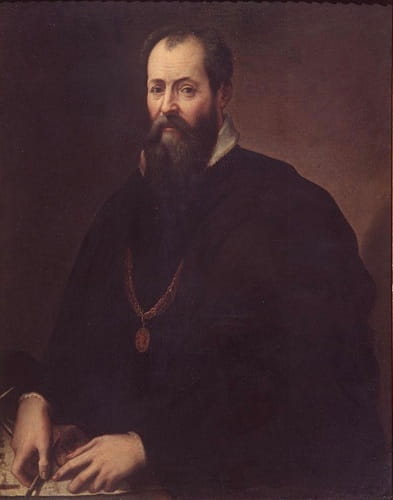
Self-portrait (c. 1571–74), by Giorgi Vasari – Uffizi Gallery
What You Will Learn:
- First-hand stories of Leonardo, Michelangelo, Raphael, and Botticelli
- How Renaissance workshops operated
- The rise of artistic genius in Florence
- Early ideas of artistic personality
4- Art: A World History — Elke Linda Buchholz, Susanne Kaeppele, Karoline Hille, Irina Stotland, Gerhard Buhler
The history of art in the palm of your hand!
This book is a ‘portable museum‘ — dense with images, timelines, and styles from ancient to contemporary art.
This lavishly illustrated and super-condensed history of world art is the perfect gift for any art lover.
A pocket-sized book bursting with 900 illustrations, it takes the reader from the beginnings of art in prehistory to the contemporary scene. With concise introductions devoted to every significant art movement, this volume guides readers from the caves at Lascaux to the 21st-century masters, and teaches them to easily distinguish between Mannerism and High Renaissance, the Baroque and Rococo, Surrealism and Dada.
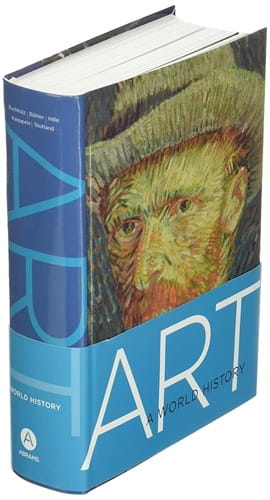
Art: A World History by Elke Linda Buchholz, Susanne Kaeppele, Karoline Hille, Irina Stotland, Gerhard Buhler – Best Art Books.
Recommended For You – The Life of Vincent van Gogh and Paintings
What You Will Learn:
- Key movements explained visually
- Quick comparisons between cultures
- Global art beyond Europe
- Recommended Artworks
- African, Asian, and Middle Eastern collections
- Egyptian funerary art
- European Renaissance and Baroque highlights
5- The Story of Art Without Men — Katy Hessel
A Modern, Feminist Rewrite of Art History
From Leonardo da Vinci to Jean-Michel Basquiat, the great painters and sculptors who have defined the fine art canon have largely been men. Katy Hessel seeks to right that wrong by cataloging, celebrating, and elevating women artists and placing their groundbreaking work in its historical, political, and cultural context. From the Renaissance to the present day, Hessel breaks down each time period and movement using a global lens, expanding the canon to include the work of non-Western artists, queer and racially marginalized artists, photographers, textile artists, and more.
Katy Hessel corrects centuries of exclusion by highlighting women artists often erased from mainstream narratives.
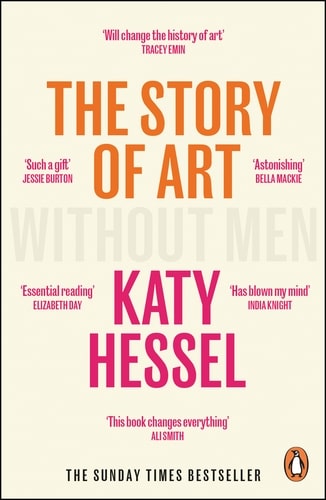
The Story of Art Without Men by Katy Hessel.
What You Will Learn:
- Why women were historically excluded
- Forgotten pioneers of medieval and renaissance art
- Women-led movements in modernism
Recommended For You – The Influential Women of Art History: Unveiling Their Untold Stories
6- Art & Fear — David Bayles & Ted Orland
A Guide to the Creative Process
Although not a history book, this is essential reading for understanding how artists work, struggle, and grow.
This is a book about making art. Ordinary art. Ordinary art means something like: all art not made by Mozart. After all, art is rarely made by Mozart-like people; essentially, statistically speaking, there aren’t any people like that. Geniuses get made once a century or so, yet good art gets made all the time, so to equate the making of art with the workings of genius removes this intimately human activity to a strangely unreachable and unknowable place. For all practical purposes, making art can be examined in great detail without ever getting entangled in the very remote problems of genius.
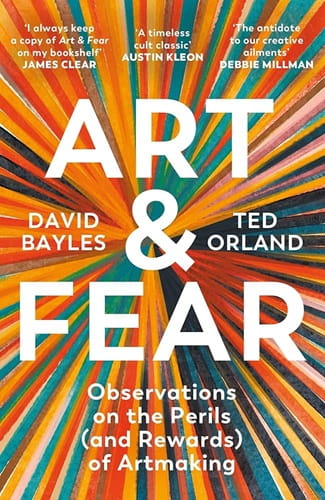
Art & Fear by David Bayles & Ted Orland
What You Will Learn:
- Why artists experience fear
- How to overcome creative blocks
- How art develops over time
7- The Annotated Mona Lisa — Carol Strickland
A Visual, Easy-to-Understand Introduction
The Annotated Mona Lisa became famous because it solves a major problem:
Most art history books are too dense, too academic, or too overwhelming. This one makes everything clear.
Strickland breaks down 20,000 years of art history into short, visually organized, easy-to-understand sections using: Charts, diagrams, timelines, side-by-side comparisons, and annotated artworks (explaining each part)
Because of this, the book is consistently recommended by museum educators, high school AP Art History teachers, and university introduction courses.
It has become a gateway book — the ideal starting point for anyone who wants to understand art before visiting a museum.
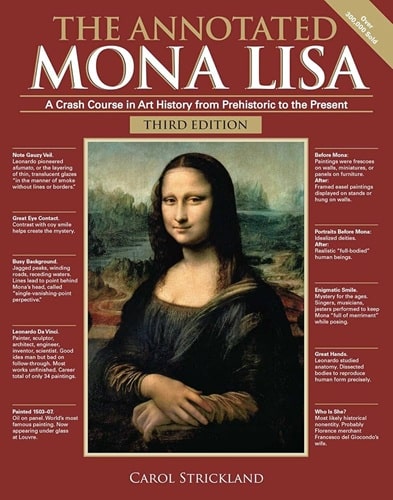
The Annotated Mona Lisa by Carol Strickland – The best art books.
What You Will Learn:
- Key concepts like color theory and perspective
- Explanations of major movements
- Visual diagrams and timelines

Mona Lisa, 1503-1506 by Leonardo da Vinci.
Recommended For You – 15 Facts You Might Not Know About The Mona Lisa
8- The Art Book — Phaidon Editors
A visual encyclopedia featuring hundreds of artists, each with a single defining artwork.
The latest, thoroughly revised edition of Phaidon’s award-winning and globally best-selling art survey, featuring works from more than 600 of the world’s greatest artists.
The Art Book is beloved throughout the world and has been translated into 20 languages, introducing millions of readers to great art and artists. Each of the more than 600 artists included, dating from medieval to modern times, is represented by a key work and an informative, explanatory text on the piece and its creator.
Breaking with traditional classifications, The Art Book is organised by artist name, throwing together brilliant examples from all periods, schools, visions, and techniques in a vibrant A-Z sequence to create an unparalleled visual sourcebook and a celebration of our rich, multifaceted culture.
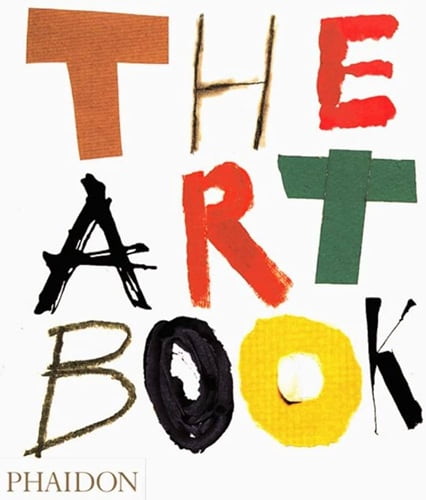
The Art Book by Phaidon Editors.
What You Will Learn:
- Artist-by-artist overviews.
- A broad survey of styles and periods.
9- The Power of Art — Simon Schama
A compelling narrative showing how great art emerges from drama, struggle, and revolution.
Great art has dreadful manners…’ Simon Schama observes at the start of his epic exploration of the power, and whole point, of art.
‘The hushed reverence of the gallery can fool you into believing masterpieces are polite things, visions that soothe, charm, and beguile, but actually they are thugs. Merciless and wily, the greatest paintings grab you in a headlock, rough up your composure and then proceed in short order to re-arrange your sense of reality…’
With the same disarming force, Power of Art jolts us far from the comfort zone of the hushed art gallery, as Schama closes in on intense make-or-break turning points in the lives of eight great artists who, under extreme stress, created something unprecedented, altering the course of art forever.
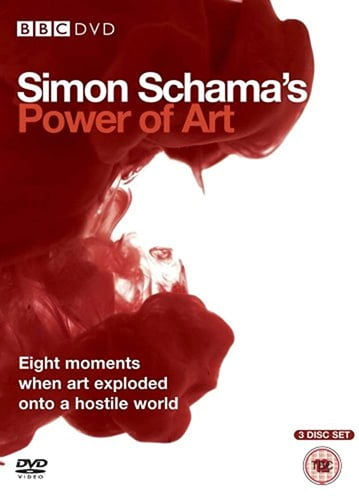
The Power of Art by Simon Schama – Best Art Books.
What You Will Learn:
- How art interacts with history and politics.
- Why certain artworks changed the world
- Life stories of 8 artists.
- Caravaggio – David with the Head of Goliath (c. 1610)
- Bernini – Ecstasy of Saint Teresa (1657)
- Rembrandt – The Conspiracy of Claudius Civilis (1662)
- David – The Death of Marat (1793)
- Turner – The Slave Ship (1840)
- Van Gogh – Wheatfield with Crows (1890)
- Picasso – Guernica (1937)
- Rothko – Black on Maroon (1958)

The Slave Ship, 1840 by Joseph Mallord William (J.M.W.) Turner – Romanticism Art.
10- The Elements of Drawing — John Ruskin
For understanding technique, no guide is better than Ruskin’s detailed instructions on seeing and drawing.
John Ruskin—one of the most influential art critics of the 19th century—believed that learning to see is the foundation of understanding art. The Elements of Drawing (1857) is not only a drawing manual; it is a philosophical guide to observation.
Ruskin wrote the book to teach readers how to look at the world with the precision, curiosity, and sensitivity of an artist.
For museum visitors, this book is transformative: it changes the way you perceive line, texture, shadow, and form—even when you’re not holding a pencil.
The Elements of Drawing by John Ruskin
What You Will Learn:
- How artists observe form, shadow, and composition
- Techniques behind realistic drawing
- What to look for in fine detail
Whether you’re visiting a major institution like the Louvre or MoMA—or exploring a small regional gallery—your experience becomes far richer when you understand the stories, techniques, and ideas behind the artworks. These best art books that equip you with exactly that knowledge.
Great art rewards preparation. The more you learn before your visit, the more powerful and meaningful every artwork becomes. These books are your passport to a richer museum experience—one that stays with you long after you’ve left the gallery.
References:
- https://www.louvre.fr/en/visit/hours-admission
- https://artsandculture.google.com/partner/rijksmuseum?hl=en
- https://archive.org/details/in.ernet.dli.2015.29158/mode/2up
- https://www.google.com.tr/books/edition/Ways_of_Seeing/QxdperNq5R8C?hl=en&gbpv=1&dq=Ways+of+Seeing+%E2%80%94+John+Berger&printsec=frontcover
- https://www.moma.org/audio/playlist/180/2390
- https://www.google.com.tr/books/edition/The_Lives_of_the_Artists/0ZlPAAAAMAAJ?hl=en&gbpv=0&bsq=The%20Lives%20of%20the%20Artists%20%E2%80%94%20Giorgio%20Vasari
- https://www.google.com.tr/search?sca_esv=8994b4a378b58ce1&hl=en&q=Giorgio+Vasari&stick=H4sIAAAAAAAAAONgVuLQz9U3KCjLK3zEaMwt8PLHPWEprUlrTl5jVOHiCs7IL3fNK8ksqRQS42KDsnikuLjgmngWsfK5Z-YXpWfmK4QlFicWZQIASoHesVMAAAA
- https://en.wikipedia.org/wiki/Giorgio_Vasari
- https://thepenitentreview.com/2023/03/15/katy-hessel-the-story-of-art-without-men/
- https://hirshhorn.si.edu/explore/the-story-of-art-without-men-katy-hessel/
- https://www.google.com.tr/books/edition/Art_Fear/hQB-5IxA9lcC?hl=en&gbpv=1&bsq=Art+and+Fear+LIB/e:+Observations+on+the+Perils+(and+Rewards)+of+Artmaking+Ted+Orland&dq=Art+and+Fear+LIB/e:+Observations+on+the+Perils+(and+Rewards)+of+Artmaking+Ted+Orland&printsec=frontcover
- https://www.goodreads.com/book/show/62854296-the-annotated-mona-lisa-third-edition
- https://www.phaidon.com/products/the-art-book?srsltid=AfmBOorWIraYsr6XkP23CtQAFQLKolU8q6M621ezuJH0bf2WTZCpZqnb
- https://en.wikipedia.org/wiki/Simon_Schama%27s_Power_of_Art
- https://www.google.com.tr/books/edition/The_Elements_of_Drawing/k_DSCQAAQBAJ?hl=en&gbpv=1&dq=The+Elements+of+Drawing+by+John+Ruskin&printsec=frontcover
- https://cushing-malloy.com/2019/12/02/17-ways-to-find-good-books-to-read/