Ethics of AI Art: Creativity, Copyright, and the Future of the Artist
The ethics of AI art have become the central debate of the digital era, as the emergence of Generative Artificial Intelligence is not merely a technological shift but an existential earthquake. When analyzing the ethics of AI art, we must look beyond aesthetics to the heart of what it means to be human, to be creative, and to own the fruits of labor.
When an algorithm can conjure a masterpiece in seconds based on a simple text prompt, we are forced to confront a profound crisis.
The ethics of AI art extend far beyond questions of aesthetics; they cut to the heart of what it means to be human, to be creative, and to own the fruits of labor. This analysis moves beyond the surface-level debate of “human vs. machine” to explore the complex, multi-layered ethical, legal, and philosophical labyrinth that defines the new creative economy.
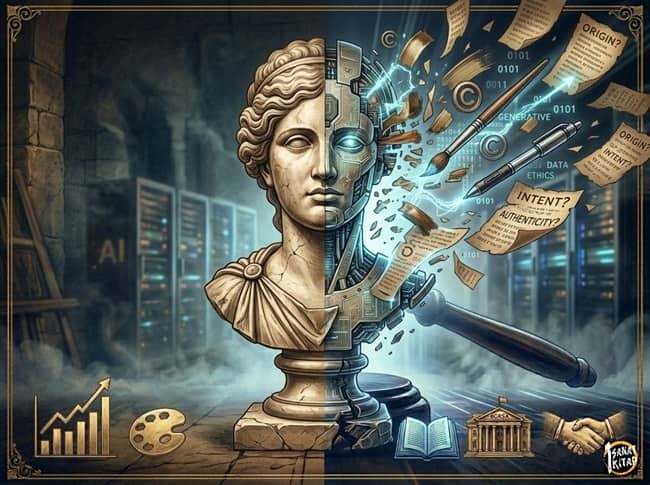
Ethics of AI Art: Creativity, Copyright, and the Future of the Artist.
Ethics of AI Art: Creativity, Copyright, and the Future of the Artist
Can AI Be Creative? The Turing Test for AI Art Ethics
The first ethical hurdle is metaphysical: Can a machine, lacking consciousness and emotion, truly be “creative”? Traditional definitions of art tie creativity to the human experience—suffering, joy, and intention. However, Gen-AI tools like Midjourney or Stable Diffusion utilize vast artificial neural networks to identify and synthesize patterns, effectively mimicking the styles of thousands of artists.
If creativity is defined merely as the ability to generate a novel and valuable output, then Gen-AI is undeniably creative. But if art requires an underlying intent, a message, or a soul, then AI is simply an incredibly sophisticated mirror, reflecting human biases and inputs back at us. This debate, known as “The Turing Test for Art,” is central to whether AI can be creative. For birsanatbirkitap.com, we argue that while AI is an unmatched tool for generation, true creation remains a uniquely human, intentional act—a critical distinction that impacts both cultural and economic value.
Recommended For You – Can artificial intelligence (AI) be an artist?
Data Scraping and the “Fair Use” Dilemma: The Foundation of AI Art Copyright Issues
The economic core of the ethics of AI art crisis lies in the way these models are trained. AI systems do not create from nothing; they learn from massive datasets containing billions of images, most of which were scraped from the internet without the consent of the original artists. This practice raises fundamental questions about data scraping ethics. Are companies like OpenAI and Stability AI building commercial, multi-billion-dollar products on stolen labor?
Artists argue that this is a colossal act of appropriation. They point to the fact that AI users often create art “in the style of” a specific living artist, directly competing with and devaluing that artist’s work. The AI companies counter with the defense of “Fair Use,” arguing that the machine is only analyzing mathematical patterns, much like a human artist studies a museum collection. However, legal systems are struggling to categorize this new form of machine learning. This battleground is the single most significant factor driving AI art copyright issues, and its resolution will determine the economic landscape for human creators.
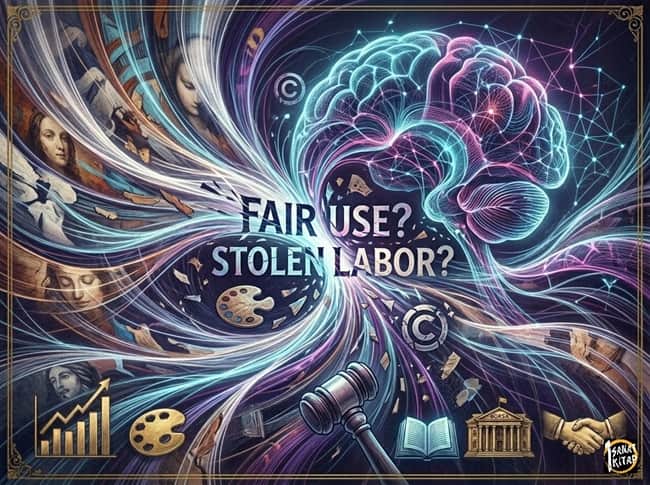
Ethics of AI Art: Fair Use? Stolen Labor?
The Legal Vacuum: Authorship and Derivative Works
Current copyright laws were designed for human authors, not autonomous algorithms. If an AI generates an image based on a prompt, who owns the result? The user who typed the prompt? The company that built the model? Or the algorithm itself? In the United States, the Copyright Office has repeatedly ruled that works created without human authorship cannot be copyrighted.
This legal vacuum creates a profound ethical paradox. While AI outputs cannot be copyrighted, they are often used to create derivative works that directly mimic protected human art. This devalues the original work while offering the AI user a form of protection. The intellectual property art system is cracking under the strain, and a new framework that separates the “act of prompt-writing” from the “act of creation” is urgently required to protect the moral rights of artists and the integrity of the Western Canon.
Algorithmic Bias and the Ethical Challenges of Generative AI Aesthetics
Beyond copyright, the ethics of AI art must address algorithmic bias. AI models reflect the data they are trained on, which inevitably contains societal prejudices regarding race, gender, and culture. A prompt for “a successful CEO” will disproportionately generate images of white men, reinforcing existing stereotypes.
Furthermore, there is an aesthetic cost. Gen-AI tools prioritize popular, optimized patterns, leading to a “homogenization” of aesthetics. If a majority of users select a certain “style,” the model learns to favor that style, potentially flattening the rich diversity of human expression into a set of predictable, algorithmic conventions. This is a critical factor for the future of human artists, as the ability to offer authentic, diverse, and flawed human perspectives becomes an artist’s most valuable asset.
Recommended For You – Anatomy of Digital Soul: Can AI Achieve Consciousness?
The Economic Displacement: A Threat to the Livelihood of Human Artists
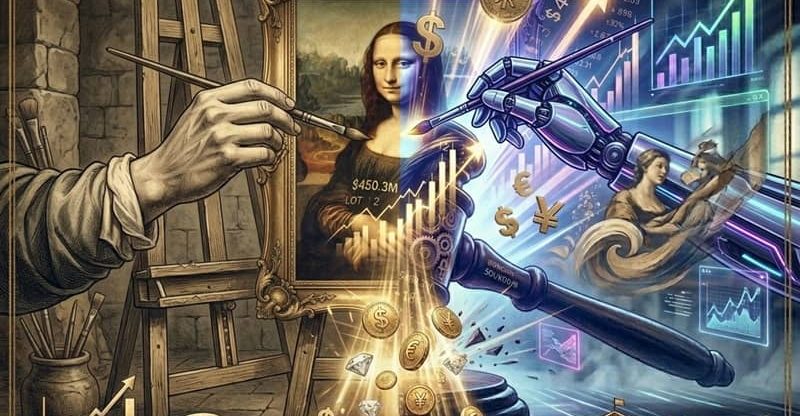
For many, the most pressing ethical concern is the automation of creativity. The speed and low cost of AI art generation are directly threatening the livelihoods of concept artists, illustrators, and designers. Why commission a human artist for thousands of dollars when a Midjourney subscription can produce an acceptable result for a fraction of the price?
This leads to a profound economic displacement. While technology always reshapes labor, the speed with which AI is penetrating the creative industries is unprecedented. The fear is not just that human artists will lose jobs, but that the entire ecosystem of human craft—the dedication, the years of practice, and the transmission of skill—will be rendered obsolete. The long-term consequence could be a hollowing out of the creative workforce, a concern that directly impacts the search for meaning in both art and life.
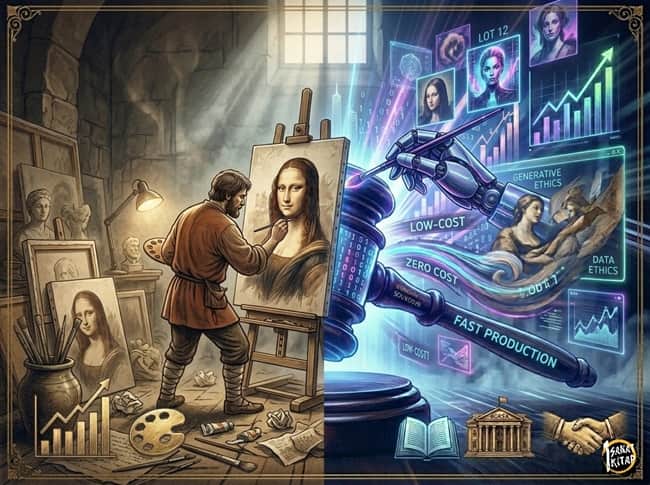
The Economic Displacement: A Threat to the Livelihood of Human Artists.
Recommended For You – 15 Facts You Might Not Know About The Mona Lisa
The Future: Coexistence, Collaboration, and Ethics of Human-AI Interaction
Despite the existential threats, the future is likely not a complete replacement but a form of coexistence. The most optimistic ethical framework sees AI not as a competitor but as a powerful collaborator—a new type of brush.
Human artists are already using AI to rapid-prototype ideas, generate complex textures, or explore new color fields. This emerging model, human-AI collaboration, prioritizes authentic human intent. The role of the human artist shifts from the generation of the work to the curation of the algorithm. The final work is not the product of the machine but a manifestation of the human artist’s vision, guided and enhanced by the AI’s data-driven capabilities. This hybrid model offers a path forward, one that we believe will define the next chapter of The Evolution of Art Curation.
The Permanent Crisis of Authenticity
The ethics of AI art represent a permanent crisis of authenticity. We have entered an era where “what we see” is no longer a reliable reflection of “what is true.” For birsanatbirkitap.com, this crisis is a call to action. As AI continues to automate the production of imagery, the core function of art—to bear witness to the human condition—becomes more sacred than ever. The artist of the future is not the one who can write the best prompt, but the one who can navigate this technological storm with intellectual property integrity, profound intention, and a unique human voice. The future of creativity is not just about what a machine can do, but about what a human must do to find meaning.
(References)
- Boden, M. A. (1998). The Creative Mind: Myths and Mechanisms. Basic Books.
- Lessig, L. (2004). Free Culture: How Big Media Uses Technology and the Law to Lock Down Culture and Creativity. Penguin.
- The Art Newspaper: Legal Challenges to AI Art and Copyright
- U.S. Copyright Office: Copyright Registration Guidance: Works Containing Material Generated by Artificial Intelligence
- Sotheby’s Institute of Art: AI Art: A Market and Ethical Perspective