Secret Language of Symbols in Art
Have you ever looked at a masterpiece and felt that something was staring back at you—not the subject, but a message? The secret language of symbols in art is not a mere conspiracy theory; it was a sophisticated survival tool for the greatest minds of the Renaissance. In an era where heresy could lead to the stake, artists like Leonardo da Vinci, Sandro Botticelli, and Hieronymus Bosch transformed their canvases into complex, encrypted maps of forbidden knowledge. To understand the secret language of symbols, we must stop looking at art as mere decoration and start reading it as a high-stakes dialogue between the elite, the occultists, and the alchemists of the 15th century.

Mona Lisa, 1503-1506 by Leonardo da Vinci – Famous Renaissance Artworks.
Recommended For You – 15 Facts You Might Not Know About The Mona Lisa
The Secret Language of Symbols: Deciphering the Occult and Alchemical Codes of the Renaissance
Why Masters Used a Hidden Alphabet: The Politics of the Occult
The use of the secret language of symbols in art was born out of necessity. During the Renaissance, the Church held absolute power over intellectual life. However, many artists were members of “secret societies” or students of Neoplatonism and Hermeticism. They sought to preserve ancient wisdom—alchemy, astrology, and sacred geometry—without alerting the Inquisition.
When you master the secret language of symbols, you realize that a simple flower, a specific hand gesture, or the placement of a shadow is never accidental. For instance, in Botticelli’s Primavera, the arrangement of the figures isn’t just a spring celebration; it is a meticulously coded botanical and astrological map. This isn’t just “academic” history; it’s the original “Easter Egg” culture that still fascinates millions of people today, driving massive traffic to those who can deconstruct these codes.
The Secret Alphabet of Primavera: Who Represents What?
-
Mercury (Far Left): He dispels the clouds with his caduceus. He is not just a deity, but the guardian of “Hermetic Wisdom.” He symbolises the purity of knowledge and the power of the intellect to dissipate the darkness of ignorance.
-
The Three Graces: Their dance represents a continuous cycle: Giving, Receiving, and Returning. This rhythmic movement is the very heart of Neoplatonic love philosophy, emphasising the fluid nature of divine grace.
-
Venus (Centre): Positioned similarly to the Virgin Mary in church iconography, she stands as the bridge between “Human Love” and “Divine Love.” She is the mediator of the soul’s journey toward the sublime.
-
Flora and Chloris (Right): This is a story of metamorphosis. We witness the transformation of the nymph Chloris, abducted by Zephyrus (the West Wind), into Flora, the goddess of flowers. This represents the evolution of the soul and the spiritual awakening of nature.
-
Hidden Botany: Each of the 500 plants in the painting carries a medicinal or mythological significance. For example, the myrtle tree behind Venus represents marriage and fidelity, while the scattered roses symbolise the complex beauty of desire.
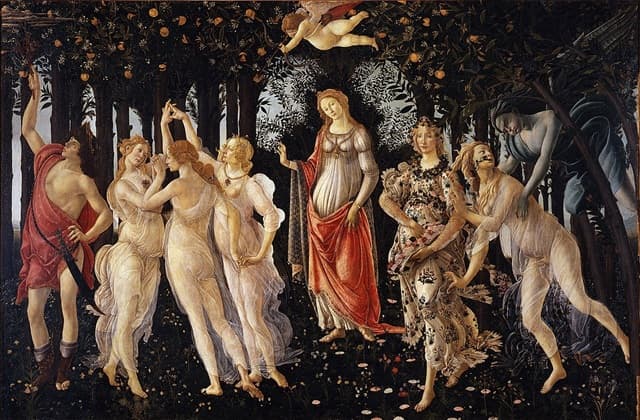
Primavera, late 1470s or early 1480s by Sandro Botticelli – Secret Language of Symbols in Art.
Alchemical Gold: Transforming Paint into Hidden Wisdom
Alchemy was the “quantum physics” of the 14th and 15th centuries. In the secret language of symbols in art, alchemy wasn’t just about turning lead into gold; it was about the perfection of the human soul. Artists used specific pigments and geometric ratios to represent the “Great Work.”
Look at the works of Jan van Eyck. The extraordinary detail in his paintings often contains alchemical glassware or specific botanical specimens that signal a “transmutation” of the viewer’s consciousness. For the modern reader, understanding this secret language of symbols adds a layer of “prestige” to the viewing experience. It transforms a museum visit into a treasure hunt, a psychological hook that keeps visitors coming back to birsanatbirkitap.com for deeper insights into the “hidden world” behind the frame.
The Mirror of Alchemy: Decoding Symbols in The Arnolfini Portrait
In the secret language of symbols, Jan van Eyck was not merely a painter but a “visual alchemist.” His mastery of oil glazes allowed him to capture light in a way that suggested the divine presence within the material world. In The Arnolfini Portrait, every object acts as a catalyst for spiritual or social transmutation:
-
The Convex Mirror (The All-Seeing Eye): At the centre of the composition, the mirror is decorated with ten scenes from the Passion of Christ. Alchemically, the mirror represents the Speculum, a tool for self-reflection and the pursuit of truth. It reflects not just the couple, but two other figures entering the room—one of whom is likely the artist himself—acting as a witness to a sacred union.
-
The Single Burning Candle: Despite the bright daylight, a single candle burns in the chandelier. This is the “Lux Eternal” (Eternal Light), representing the presence of the Holy Spirit or the “All-Seeing Eye of God.” In alchemical terms, it symbolizes the Sulfur, the active male principle and the light of consciousness.
-
The Discarded Shoes (Sacred Ground): The removal of clogs signifies that the couple is standing on “holy ground.” It transforms a domestic interior into a private chapel. This act of sanctification is a key step in the alchemical process of separating the sacred from the profane.
-
The Dog (Fidelity and Protection): While commonly seen as a symbol of marital faith (Fides), in the occult tradition, the dog is a guardian of the threshold. It bridges the gap between the physical world of the room and the spiritual world reflected in the mirror.
-
The Oranges (Forbidden Fruit and Wealth): Placed by the window, these expensive imported fruits represent both the “Garden of Eden” and the immense wealth of the Arnolfini family. Alchemically, the orange (the “Golden Apple”) symbolizes the successful completion of the Rubedo—the final stage of the Great Work where base materials turn into spiritual gold.
-
St. Margaret and the Bedpost: The carved figure on the bedpost is Saint Margaret, the patron saint of childbirth. This hidden symbol suggests that the painting is not just a marriage contract but a talisman for fertility and the continuation of the bloodline.
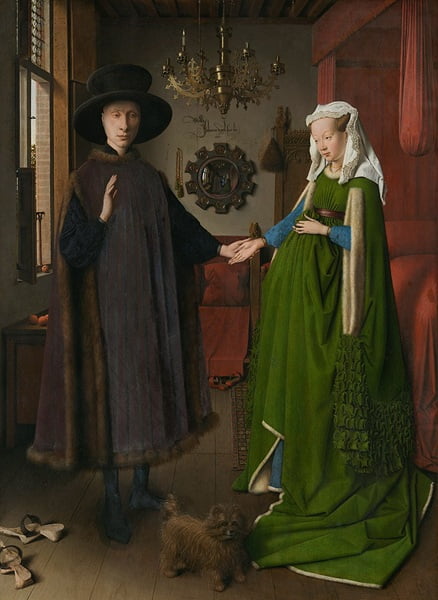
The Arnolfini Portrait, 1434 by Jan van Eyck – National Gallery, London.
Da Vinci’s Digital Ancestry: Mathematical Codes and Cryptography
Leonardo da Vinci was the undisputed master of the secret language of symbols in art. Beyond the fictionalised “Da Vinci Code,” the reality is far more interesting. Leonardo used “Mirror Writing” and “Anamorphosis” (hidden images visible only from a specific angle) to hide his scientific findings.
Recent digital scans of the Last Supper and the Mona Lisa have revealed tiny letters and numbers hidden in the pupils of the eyes—a literal secret language of symbols. These aren’t just random marks; they are part of a broader cryptographic system Leonardo used to link his anatomical studies with his artistic output.
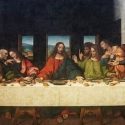
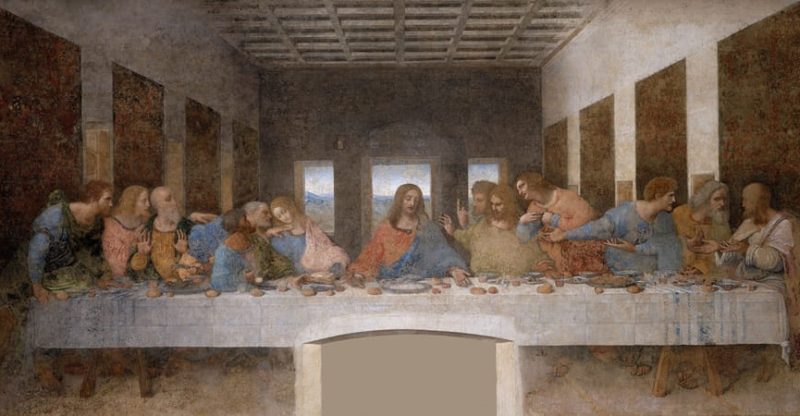
The Acoustic Code: Secret Musical Geometry in The Last Supper
In the secret language of symbols, The Last Supper is not a static mural; it is a sprawling, 15th-century musical score. Leonardo, a master musician himself, treated the placement of every element as a data point in a sophisticated multimedia interface:
-
The Musical Staff of the Apostles: If you draw the five lines of a musical staff across the painting, the hands of the Apostles and the loaves of bread on the table align perfectly with specific musical notes. When read from right to left—consistent with Leonardo’s personal “mirror writing” style—these elements form a 40-second requiem.
-
The Eucharist as a Rhythmic Pulse: The loaves of bread are not merely biblical references; they act as the “beat” of the composition. This “Hymn of the Passion” proves that Leonardo used the secret language of symbols to bridge the gap between visual art and temporal sound, creating a “Divine Harmony” that resonates with the laws of physics.
-
The Trinity in Perspective: Beyond music, the room’s architecture is a mathematical fortress. The three windows behind Christ and the triangular shape of His body represent the Holy Trinity. Leonardo utilised the “Vanishing Point” exactly at Christ’s right temple, signalling that the secret language of symbols in this room is a direct map of the human mind seeking the divine.
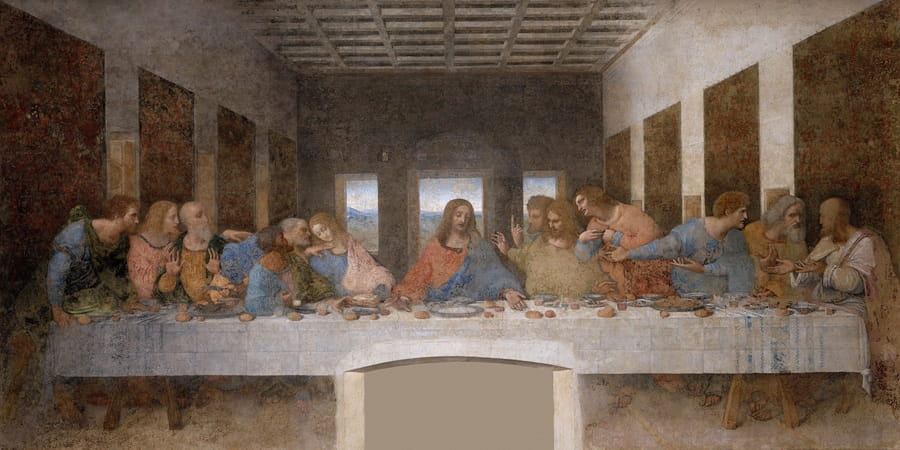
The Last Supper, 1495-1498 by Leonardo da Vinci – Secret Language of Symbols in Art.
Recommended For You – 8 Things You Need To Know About Da Vinci‘s The Last Supper
The Macrocosmic Mirror: Cryptographic Metadata in the Mona Lisa
The Mona Lisa serves as the ultimate encrypted document in the secret language of symbols. Beyond her smile lies a complex layer of “metadata” that reveals Leonardo’s obsession with the link between the human body and the Earth (The Microcosm and Macrocosm):
-
The Ocular Ciphers (LV and 72): High-definition scans of the pupils have revealed microscopic inscriptions. In the right eye, the letters “LV” (Leonardo’s signature) are embedded as a digital watermark. In the left eye, more elusive symbols appear, possibly the number “72”. In the secret language of symbols, 72 is the “Shemhamphorasch”—the 72 names of God in Kabbalistic tradition. This suggests the sitter is not merely Lisa Gherardini, but a vessel for universal divinity.
-
The Geological Bridge of Time: The landscape behind her is not a generic background. The bridge, identified as the Ponte Buriano in Arezzo, acts as a symbol of the “Flow of Time.” Leonardo meticulously aligned the curves of the river with the veins in the subject’s chest, using the secret language of symbols to demonstrate that the blood flowing through our bodies is governed by the same hydraulic laws as the water flowing through the Earth.
-
Anamorphic Distortion: Leonardo experimented with “perspective secrets.” When viewed from an extreme angle, certain shadows in the landscape shift, revealing hidden silhouettes. This early form of cryptography ensured that only those who knew how to look would see the true message: that nature and humanity are one inseparable, mathematical equation.
Mona Lisa, 1503-1506 by Leonardo da Vinci.
The Power of the Mundane: Symbols of Wealth and Status
The secret language of symbols in art wasn’t always about the supernatural; it was often about “Silent Luxury.” In Northern Renaissance paintings, a single lemon, an expensive rug from the East, or a mirror was a coded message of immense wealth and global trade.
When we deconstruct these symbols, we tap into the “Old Money” aesthetic that is currently trending worldwide. A dog in a portrait didn’t just mean “loyalty“; it signaled a specific breed that only the 1% of the time could afford. Understanding the secret language of symbols allows us to see how the elite have used art to project power and stability for centuries—a topic that resonates deeply with today’s interest in social status and financial psychology.
The Psychological Trap: Why Humans Crave Hidden Meaning
Why is the secret language of symbols in art so addictive? Psychologically, humans are “pattern-seeking” people. When we discover a “hidden code,” our brain releases dopamine. It makes us feel like “insiders” who have gained access to an exclusive club of knowledge.
By positioning birsanatbirkitap.com as the key to this club, we build a loyal community. This isn’t just about teaching history; it’s about providing the “Aha!” moment that people actively search for. Whether it’s a student looking for a thesis or a casual reader intrigued by a TikTok trend, the secret language of symbols provides a bridge between high-brow academia and pop culture.
The Immortal Cypher
The secret language of symbols in art is the ultimate testament to human ingenuity. It proves that a painting is never “just a painting.”
It is a living document, a silent scream across time, and a sophisticated puzzle waiting to be solved. As we continue to apply modern technology—AI scans, infrared reflectography, and neural analysis—to these masterpieces, the secret language of symbols only becomes more complex and rewarding. At birsanatbirkitap.com, we don’t just show you art; we give you the lens to see what has been hidden in plain sight for 500 years.
References
- Wind, Edgar (1958). Pagan Mysteries in the Renaissance. (The definitive guide to occult symbols).
- Eco, Umberto (1988). Foucault’s Pendulum. (While fiction, it explores the real history of secret societies in art).
- Panofsky, Erwin (1939). Studies in Iconology: Humanistic Themes in the Art of the Renaissance.
- Jung, Carl (1952). Psychology and Alchemy. (Understanding the universal nature of symbols).
- Wikipedia: Primavera (Botticelli)
- Wikipedia: The Last Supper