
Golden Ratio in Art: Divine Geometry or a Historical Myth?
The Golden Ratio in Classical Art stands as the most debated intersection of mathematics and human creativity, often described as a “divine fingerprint” left by the Creator in the fabric of reality. When we examine the Golden Ratio in Classical Art, we are not merely looking at numbers; we are witnessing humanity’s ancient quest to quantify the sublime. From the towering heights of the Parthenon to the meticulous sketches of Leonardo da Vinci, the ratio of approximately 1.618 (φ or ϕ) is frequently cited as the secret formula for visual perfection. However, is this “Divine Proportion” a fundamental law of nature that artists instinctively followed, or is it a romanticized historical construct? To truly understand the Golden Ratio in Classical Art, one must dissect the layers of sacred geometry, historical evidence, and the psychological allure of finding order in chaos.

The Golden Ratio in Classical Art: Divine Geometry or Historical Myth?
Golden Ratio in Art: Divine Geometry or a Historical Myth?
The Mathematics of Beauty: Understanding Phi in the Golden Ratio in Art
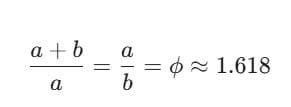
Before diving into art history, we must address the rigid mathematics of the Golden Ratio in Classical Art. The ratio is derived from a line divided into two segments ($a$ and $b$) where the ratio of the whole to the larger segment is equal to the ratio of the larger to the smaller. Mathematically:
This ratio is intrinsically linked to the Fibonacci Sequence, where each number is the sum of the two preceding ones. As the numbers increase, their ratio converges on Phi. This sequence is found in the spirals of galaxies and the arrangement of sunflower seeds, leading to the theory of Aesthetic Universalism: the idea that the human brain is evolutionarily hardwired to find the Golden Ratio in Classical Art inherently superior to any other proportion.
Phidias and the Parthenon: Did the Ancients Calculate Beauty?
The genesis of the Golden Ratio in Classical Art is almost always traced back to mid-5th century BC Athens. Phidias, the master sculptor of the Parthenon, is so synonymous with this proportion that the ratio itself is named “Phi” (ϕ) in his honor. Textbooks often overlay a “Golden Rectangle” on the Parthenon’s facade to demonstrate its perfection.
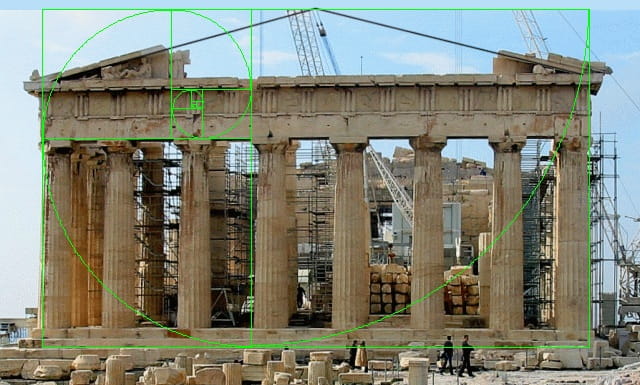
Golden Ratio Analysis of the Parthenon in Athens (438 BC): A conceptual architectural visualization illustrating the proposed application of sacred geometry to Ancient Greece’s definitive Doric temple. This high-resolution technical overlay is consistent with superimposing a precise geometric matrix, a Golden Rectangle grid, and a glowing Fibonacci spiral in Electric Blue and Copper onto the facade.
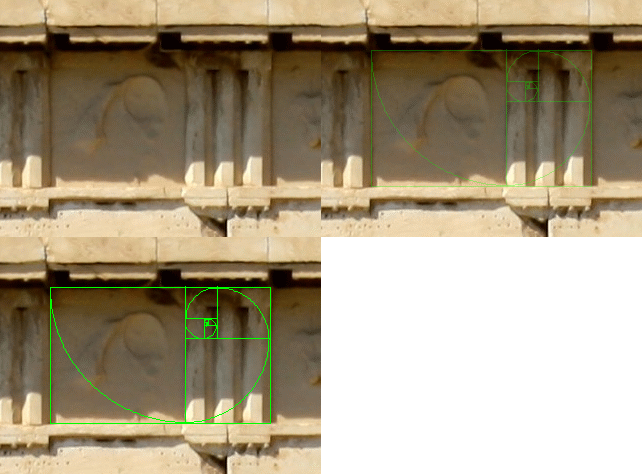
The Parthenon is a former temple on the Athenian Acropolis, Greece, that was dedicated to the goddess Athena. Its decorative sculptures are considered some of the high points of classical Greek art, and the Parthenon is considered an enduring symbol of ancient Greece, Western civilisation, and democracy. – The Parthenon was built between 447 and 432 BCE in Athens, Greece, under the direction of the statesman Pericles. The project was designed by architects Ictinus and Callicrates, with the renowned sculptor Phidias overseeing the artistic, sculptural elements and the construction of the colossal statue of Athena.
Recommended For You – Ancient Greek Gods
However, an objective architectural analysis reveals a different reality. While the Parthenon exudes a profound sense of visual harmony, modern measurements show that the Greeks primarily used a ratio of 4:9 for its dimensions. The “perfect fit” of the golden rectangle often requires analysts to conveniently ignore the building’s base or the precise apex of the pediment. This suggests that while the Greeks sought Symmetria, the application of the Golden Ratio in Classical Art during the Classical period may be a retroactive projection by 19th-century scholars.
Leonardo da Vinci and the Paradox of “De Divina Proportione”: Is the Golden Ratio in Art a Reality?
No artist is more closely associated with the Golden Ratio in Classical Art than Leonardo da Vinci. Popular culture insists that the Mona Lisa and The Last Supper were composed using rigid Fibonacci grids. This association was cemented by Leonardo’s collaboration with the monk and mathematician Luca Pacioli on his 1509 treatise, De divina proportione.
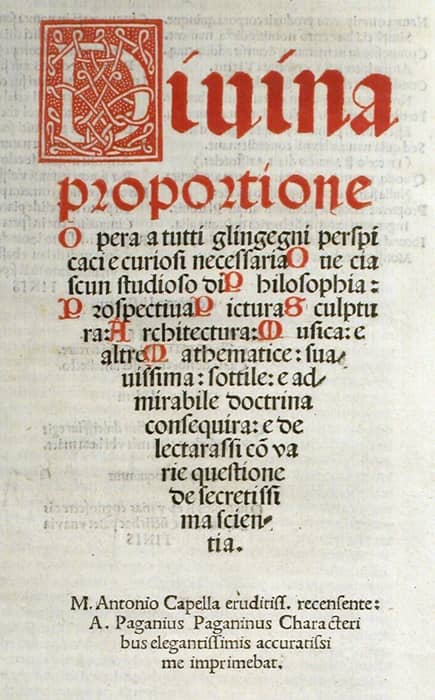
Divina proportione (15th-century Italian for Divine proportion), later also called De divina proportione (converting the Italian title into a Latin one), is a mathematics book written by Luca Pacioli and illustrated by Leonardo da Vinci, completed by February 9th, 1498, in Milan and first printed in 1509. Its subject was mathematical proportions (the title refers to the golden ratio) and their applications to geometry, to visual art through perspective, and to architecture. The clarity of the written material and Leonardo’s excellent diagrams helped the book to achieve an impact beyond mathematical circles, popularizing contemporary geometric concepts and images.
Leonardo provided the illustrations for Pacioli’s book, proving his deep interest in Divine Proportion history. Yet, his personal notebooks rarely mention $\phi$ as a compositional tool.
Leonardo was more obsessed with the Vitruvian Man and the relationship between the human form and Euclidean geometry (squares and circles). The pervasive idea that Leonardo used the Golden Ratio is likely a result of modern enthusiasts drawing spirals over his works until they fit, rather than an explicit documented technique from the master himself.
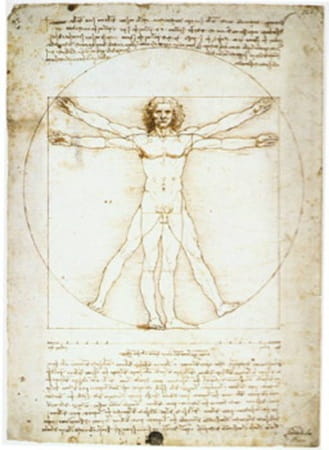
Vitruvian Man, 1490 by Leonardo da Vinci (Normalized)
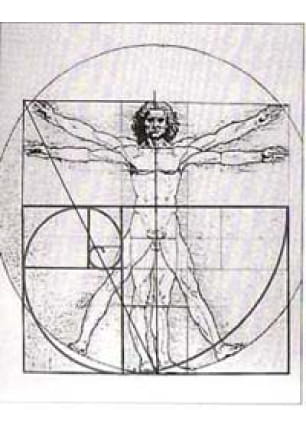
Leonardo da Vinci’s “Vitruvian Man”, showing the golden ratio in body dimensions.
The 19th Century Myth-Making: Zeising’s Aesthetic Law
If the evidence in the Renaissance is thin, why is the Golden Ratio in Classical Art so dominant today? The answer lies in the 1850s with German psychologist Adolf Zeising. Zeising claimed that the Golden Ratio was a “universal law” found in all formative striving for beauty. He measured everything—from the height of the human navel to the distance between petals on a lily—and declared that 1.618 was the fundamental constant of nature and art.
Zeising’s work transformed the Golden Ratio in Classical Art from a niche mathematical curiosity into a global dogma. His enthusiastic (and often scientifically biased) measurements provided the foundation for the “Golden Ratio myths” we see in the Great Pyramid of Giza and the music of Mozart. He created a narrative that turned the Golden Ratio in Classical Art into a romantic bridge between the spiritual and the mathematical.
Psychological Reality: Is the Golden Ratio in Art Truly Universal?
Does the Golden Ratio in Classical Art actually affect our brains? In the late 19th century, Gustav Fechner conducted the first “scientific” aesthetics test, showing that people generally preferred rectangles with a ratio close to Phi.
However, modern replications suggest that our preferences are far more flexible. Cultural background, education, and the specific context of the object play a larger role in what we perceive as “beautiful” than a single mathematical constant. The Golden Ratio in Classical Art provides a sense of comfort because it offers predictability and balance, not necessarily because it is a “divine” necessity.

The Birth of Venus, 1484-1486 by Sandro Botticelli.
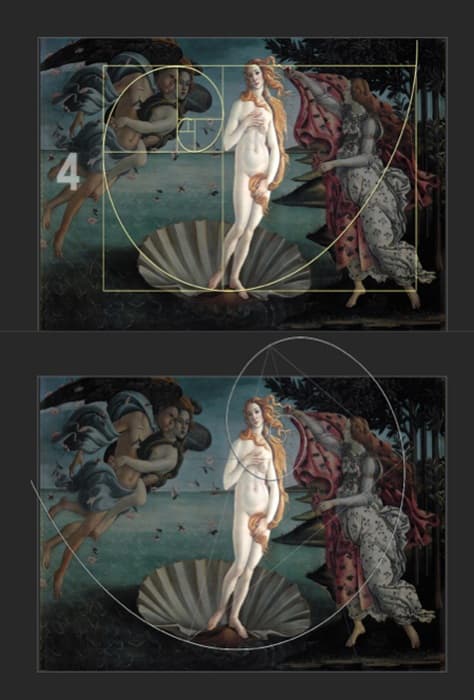
Sandro Botticelli’s “The Birth of Venus”, showing the golden ratio.
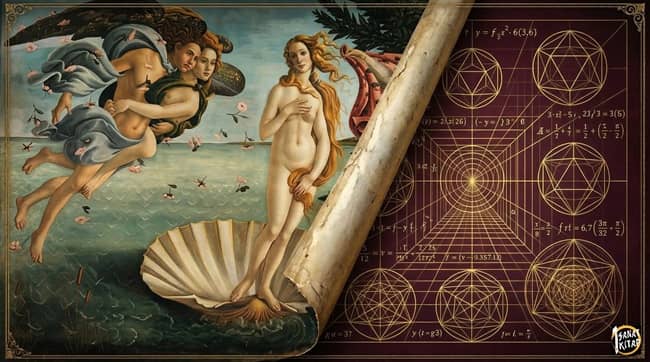
The Economics of Perfection: Phi in the Modern Market
Today, the Golden Ratio in Classical Art has transcended the museum and entered the boardroom. In the economics of fine art, attributing a Golden Ratio composition to a painting can significantly increase its perceived value and provenance. It suggests a level of intellectual rigor that justifies record-breaking auction prices. Similarly, tech giants like Apple and Twitter (X) use the Golden Spiral in their branding to imply a “natural” and “inevitable” perfection in their design, proving that the myth of the Divine Proportion is as profitable as it is beautiful.
Conclusion: The Immortal Meta-Pattern
Ultimately, the Golden Ratio in Classical Art is a testament to the human desire to find order in the infinite complexity of the world. Whether it is a historical reality or a romantic myth, the ratio remains the most elegant bridge between the precision of the scientist and the passion of the artist.
At birsanatbirkitap.com, we believe that the true “Divine Proportion” is not a number, but the human capacity to imagine that such a thing exists. We must look past the grids and spirals to see the disordered, raw beauty that makes art truly immortal.
References and Scholarly Sources
- Livio, Mario (2002). The Golden Ratio: The Story of Phi, the World’s Most Astonishing Number. Broadway Books. (The definitive modern debunking and historical analysis).
- Pacioli, Luca (1509). De divina proportione. (Illustrated by Leonardo da Vinci).
- Markowsky, George (1992). Misconceptions about the Golden Ratio. The College Mathematics Journal.
- Falbo, Clement (2005). The Golden Ratio: A Contrary View. The College Mathematics Journal.
- The British Museum: Research on Classical Greek Symmetria and Architectural Proportions.
- Wikipedia: Parthenon
- Wikipedia: Divina proportione