Dark Academia Aesthetic: The Art, Books & Philosophy Guide
The dark academia aesthetic has outlived almost every trend that was supposed to bury it. It started as a small Tumblr mood board in 2015, exploded across TikTok in 2020 when half the world was stuck indoors romanticizing libraries they couldn’t visit, and in 2026 it’s still going strong — spilling into interior design, fashion runways, and even a “summer” version built around linen and sun-warmed parchment tones. But strip away the tweed blazers and the candlelit study photos, and what’s left is something older and more interesting: a genuine hunger for the art, philosophy, and literature that the aesthetic borrows its whole identity from.

Dark Academia Aesthetic
What Is the Dark Academia Aesthetic, Really?
Most style guides trace dark academia’s visual DNA to Donna Tartt’s 1992 novel The Secret History, a quiet, unsettling story about a group of classics students at an elite New England college. The book’s atmosphere — gothic buildings, obsessive scholarship, ancient Greek texts, and a group of students a little too in love with the idea of being brilliant — became the aesthetic’s founding myth long before Pinterest or TikTok existed to spread it.
What people are actually responding to isn’t the wardrobe. It’s the fantasy of a life organized around curiosity instead of notifications: a desk lamp instead of a phone screen, a worn paperback instead of a feed. That’s precisely why the dark academia aesthetic keeps resurfacing in new forms rather than fading like a typical microtrend — it’s less about clothes and more about a craving for depth.
The Gothic Architecture and Art Behind Dark Academia
Long before “dark academia” was a hashtag, painters were already obsessed with the same visual language: dim interiors, dramatic lighting, and a sense that a single room could hold centuries of accumulated meaning. Renaissance artists in particular built entire compositions around hidden symbolism and quiet intellectual references — the same layered, “there’s more than meets the eye” quality that dark academia spaces try to recreate with stacked books and mismatched candlesticks. If you want to see where that instinct actually comes from, our piece on the hidden philosophical meaning tucked inside da Vinci’s and Botticelli’s most famous works is a natural next stop — it’s the art-historical ancestor of the whole aesthetic.
Gothic architecture supplies the other half of the mood: pointed arches, vaulted ceilings, and stone corridors built to make a person feel small in front of something ancient. It’s not an accident that university libraries modeled on medieval cathedrals became the aesthetic’s unofficial cathedral of choice.

The Cologne Cathedra – Dark Academia Aesthetic.
The Philosophy Every Dark Academic Should Actually Read
Here’s where most dark academia content stops at the mood board, and this guide won’t. If the aesthetic is genuinely about romanticizing the pursuit of knowledge, the philosophy shelf is where that pursuit gets tested against real difficulty — grief, mortality, meaning, control.
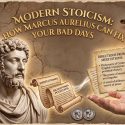
Stoicism is the obvious starting point, and not just because Marcus Aurelius makes a very photogenic marble bust. The Stoics were writing exactly the kind of unflinching, notebook-style self-examination that dark academia claims to love in theory. We’ve already covered how Marcus Aurelius turned a genuinely brutal life into a working philosophy for bad days — it’s essential reading for anyone drawn to this aesthetic for more than its color palette.
From there, existentialism and absurdism pick up where Stoicism leaves off, asking a harder question: what do we do once we admit that meaning isn’t handed to us?
The Books That Built the Aesthetic
Beyond The Secret History, the dark academia reading canon leans heavily on classical tragedy and 19th-century literature: Greek plays, Dostoevsky’s moral spirals, the Brontës’ gothic romances, anything with a crumbling estate or a morally compromised professor. The appeal isn’t nostalgia for a specific era — it’s nostalgia for books that took their own ideas seriously.
.

The Books That Built the Aesthetic.
If you’re the type of reader who wants actually to work through a stack like that — tracking what you’ve finished, marking favorite passages, building toward a real personal canon rather than just a Pinterest board — that’s precisely the use case a reading-companion app like Bookmory is built around. A dark academia reading list only means something if you actually finish it.
Beyond the Tweed: Is Dark Academia More Than a Look?
The fair criticism of dark academia is real: it can romanticize elite, mostly white, historically exclusionary institutions while ignoring who actually got to attend them. It’s worth holding both truths at once — the aesthetic borrows imagery from a narrow, specific slice of academic history, and the underlying hunger it taps into (for depth, focus, unhurried reading) is genuinely worth taking seriously, regardless of where the wardrobe references come from.
The honest version of dark academia isn’t cosplay. It’s rearranging your actual habits — what you read, how you spend an evening, whether you finish books or just photograph them — around the same values the aesthetic borrows its imagery from.
How to Start Living It, Not Just Wearing It
A few genuinely useful starting points, no blazer required:
- Pick one primary text, not ten summaries. Read an actual Stoic text or a real Greek tragedy before you read a listicle about it.
- Build an evening reading habit. The Stoics already had a version of this — a nightly review of the day, done with a notebook instead of a phone.
- Track what you finish. A reading list you never complete is just an aesthetic. A reading list with actual progress on it is a practice.
- Let the mood follow the substance, not the other way around. The candlelight looks better next to a book you’re actually reading.
The Bottom Line
The dark academia aesthetic has survived a decade of trend cycles because it was never really about tweed — it was a proxy for wanting a slower, more serious relationship with ideas. Strip away the wardrobe and what’s left is a genuinely good reading list, a handful of philosophers worth actually arguing with, and an art history full of rooms that already looked like this centuries before Pinterest existed.
References
- “How to Design Your Home With the Dark Academia Aesthetic.” Extra Space Storage, extraspace.com
- “From Tumblr to TikTok, This Moody Aesthetic Is Back Again in 2026.” Bed Threads Journal, bedthreads.com
- “What Exactly Is Dark Academia? Guide To The Trendy Aesthetic.” Classpop! Magazine, classpop.com
- https://www.deutschland.de/en/topic/culture/cologne-cathedral-history-significance-architecture