Color Psychology in Art
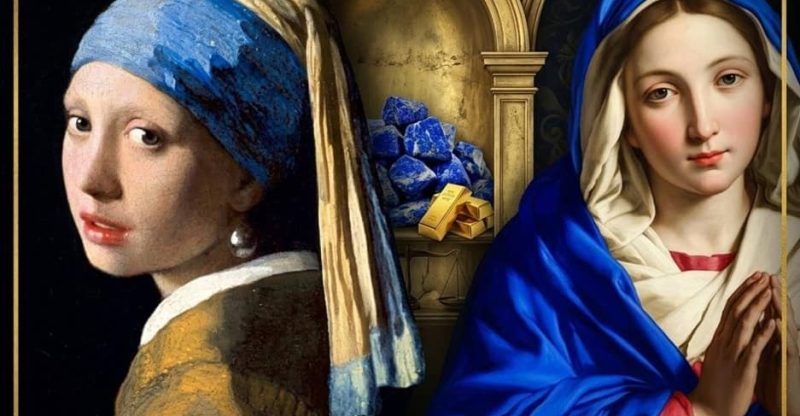
In the vast landscape of art history, few elements carry as much weight, both metaphorically and financially, as the color blue. When we analyze color psychology in art, we often look for emotional resonance, yet in the Renaissance period, the presence of blue was a statement of divine sanctity and immense wealth. To understand the evolution of visual storytelling, one must look beyond the brushstrokes and into the very minerals that defined the era’s most iconic works.
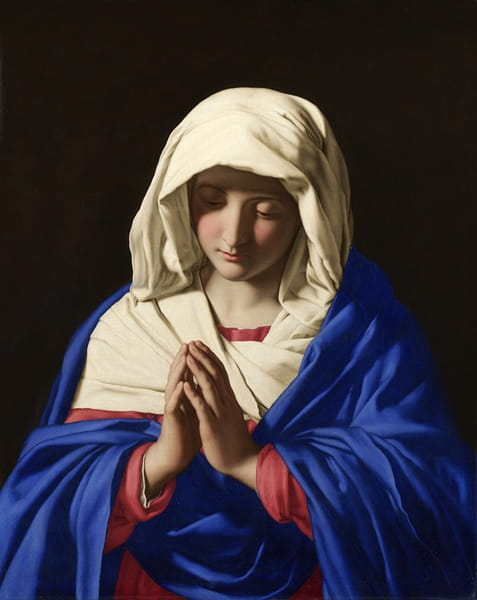
The Virgin in Prayer, 1640–1650 by Giovanni Battista Salvi da Sassoferrato – National Gallery, London, UK – Color Psychology in Art -Color psychology in art demonstrated through the Virgin Mary’s blue robe.
Color Psychology in Art: Why Blue Cost More Than Gold in the Renaissance
The Sacred Economics of Color Psychology in Art
During the 14th to 17th centuries, the pigment known as “Ultramarine” was literally “from beyond the seas.” Sourced from the Lapis Lazuli mines in the remote mountains of Afghanistan, it arrived in Venice via the Silk Road. Its cost was prohibitive, and it was frequently listed in artistic contracts as a separate expense, often exceeding the price of gold leaf.
This economic reality directly influenced the Renaissance masterpieces we admire today. Patrons did not just pay for an artist’s skill; they paid for the weight of the blue. This led to a fascinating psychological association: blue became the color of the divine, reserved almost exclusively for the robes of the Virgin Mary and Christ. When a viewer saw blue, they weren’t just seeing a hue; they were witnessing a sacrifice of wealth in honor of the sacred.
Michelangelo and the “Unfinished” Blue
The scarcity of blue pigments led to some of the most intriguing stories in art history. One notable example is Michelangelo’s The Entombment. If you examine the painting closely, there is a large, empty space in the bottom right corner intended for the Virgin Mary. Legend suggests that Michelangelo never finished the piece because he couldn’t secure the funds for the necessary Ultramarine. This highlights a crucial aspect of color psychology in art: the absence of color can be as telling as its presence.
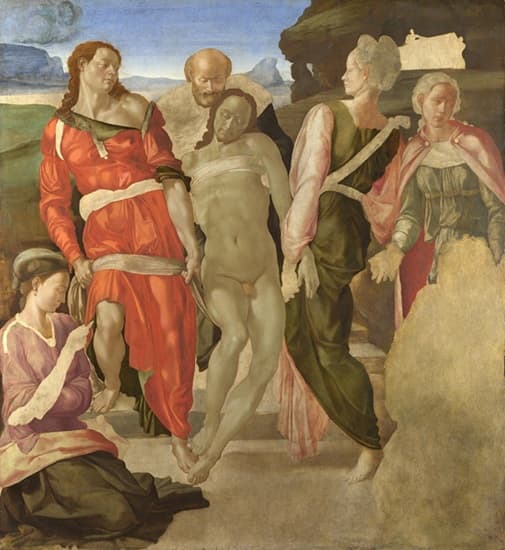
The Entombment, 1500-1501 by Michelangelo – National Gallery, London – Color Psychology in Art -Renaissance art techniques and the absence of blue pigment in Michelangelo’s work.
Beyond Beauty: The Nuro-Aesthetic Impact
Modern science and neuroaesthetics tell us that blue is one of the most complex colors for the human brain to process in an artistic context. It has the shortest wavelength, which often makes blue objects appear to be receding, creating a sense of depth and infinite space—the “celestial” feeling that Renaissance masters aimed for.
By utilizing blue as the focal point, artists like Titian and Perugino were not just painting a sky or a garment; they were manipulating the viewer’s spatial perception to evoke a sense of peace and transcendence. This is where the academic study of art meets the raw, emotional power of human psychology.
Vermeer’s Obsession and Financial Ruin
Moving into the late Renaissance and early Baroque, Johannes Vermeer’s use of blue reached its zenith. Unlike many of his contemporaries who used blue sparingly, Vermeer was obsessed with its purity. In his masterpiece Girl with a Pearl Earring, the headscarf is a brilliant display of natural Ultramarine.
However, this obsession came at a cost. Many historians believe that Vermeer’s insistence on using the most expensive pigments, even when his family faced financial hardship, contributed to his eventual bankruptcy. This commitment to the medium transformed the symbolism of blue from a religious requirement into an individualistic artistic signature.
.
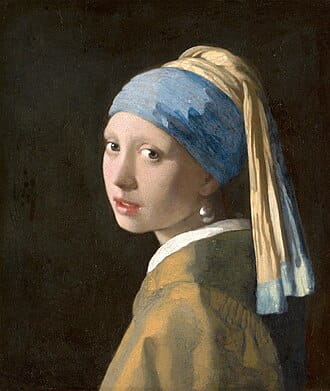
Girl with a Pearl Earring, 1665 – Johannes Vermeer (Jan Vermeer) – Mauritshuis, The Hague, Netherlands.
Recommended For You – 8 Amazing Facts About The Girl with a Pearl Earring by Vermeer
The Transition to Synthetic Blues
The monopoly of Lapis Lazuli eventually broke in the early 19th century with the invention of “French Ultramarine,” a synthetic alternative. While this democratized the color, the psychological weight of the “precious blue” began to shift. Today, we use blue in marketing to denote trust and stability (think of tech giants like Meta or LinkedIn), but in the galleries of the Uffizi or the Louvre, blue remains a ghostly echo of a time when color was as precious as a kingdom.
Understanding the history of pigments is essential for any modern artist or collector. For those interested in how these traditions evolved into modern practices, one might explore our previous analysis on The Evolution of Art Curation. Furthermore, the chemical composition of these pigments is often studied by institutions like the Getty Conservation Institute, which specializes in preserving these centuries-old blue hues for future generations.
Conclusion: The Legacy of the Azure Hue
The story of blue in Renaissance art is a testament to the intersection of commerce, chemistry, and soul. It teaches us that art is never just about what we see; it is about the history of the materials, the struggle of the artist, and the psychological impact of the spectrum. As you look at a masterpiece today, ask yourself: What was the price of that color, and how does it make you feel?
(References)
- Pastoureau, M. (2001). Blue: The History of a Color. Princeton University Press.
- Ball, P. (2001). Bright Earth: Art and the Invention of Color. University of Chicago Press.
- The Metropolitan Museum of Art (Met): Ultramarine Pigment in the Renaissance
- National Gallery, London: Pigments through the Ages
- Wikipedia: The Virgin in Prayer
- Wikipedia: The Entombment
- Wikipedia: Girl with a Pearl Earring